Science Week - Year 2
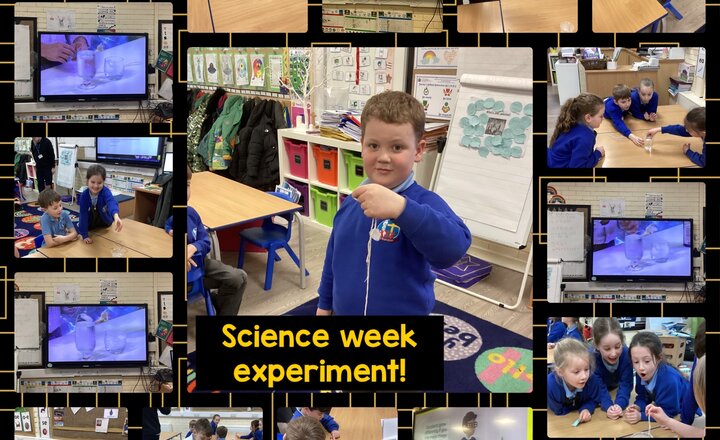
This Science Week, we have been thinking about curiosity and asking lots of questions like can you pick up an ice cube without using your hands? With the help of some salt to lower the temperature of the water, we managed it!
Year 4 - British Science Week Investigation
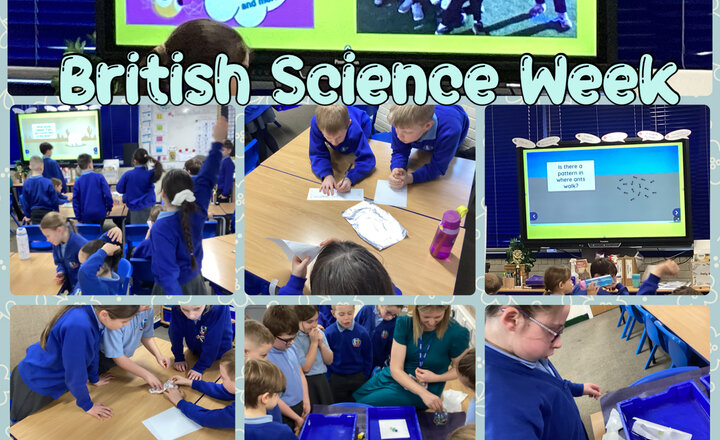
Our curious Year 4 class loved their British Science Week investigation. Their objective was to build a small raft to hold as many marbles as possible without sinking. The children only had plain paper, masking tape and tin foil. After each build, the children tested their raft and recorded the number of marbles held. They then had to decide as a group how they would improve on their design and make their next raft. Each group made a total of four rafts and the maximum number of marbles held on one raft was 60 - amazing! As part of this special session, the children also took part in a quiz, learned some weird and wonderful scientific facts and had the opportunity to ask their own curiosity questions.
Year 4 Class Worship and Horrible Science Assembly
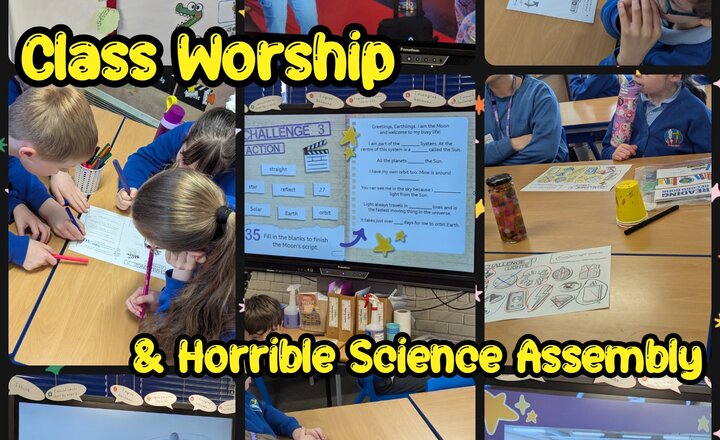
Today, Year 4 had an extended class worship. The first part followed on from yesterday's collective worship about sharing what we have. We talked about ways we have shared with others and times when someone has shared something small, but it has had a big impact on us. We added some of our ideas to our kindness kite. We also took part in the Big Live Horrible Science Assembly for British Science Week. The topic was light & space, with guest speakers, including British astronaut Tim Peake. The children recapped some of the information they had learned in Years 2 & 3, and learned lots of interesting new facts that will help them when they meet their Year 5 space topic. They also completed challenges in groups based on the information presented.
.jpeg)
Year 6 - British Science Week
As part of British Science Week, Year 6 explored the question: What makes great teamwork? The children took part in a practical challenge where they worked in small groups to control a single pen. Each of the children held a peg, and the pegs were clipped to the pen. Without touching the pen directly, they had to communicate and work together to draw a series of pictures that were given to them. This activity encouraged the children to think about the importance of communication, patience, listening and cooperation. They quickly realised that successful teamwork requires everyone to contribute, share ideas and support one another in order to achieve a common goal. The challenge also showed how scientists and engineers often rely on teamwork and collaboration to solve problems and create solutions.
.jpeg)
Year 4 DT Electrical Posters
In our second DT session we researched a set topic to develop a range of initial details. We decided to choose between The Amazon Rainforest or Roman Britain as we have recently studied both topics. We noted our key findings into fact boxes and a spider diagram and then sketched untold ideas for our electric posters to meet a design criteria.
Year 5 - British Science Week
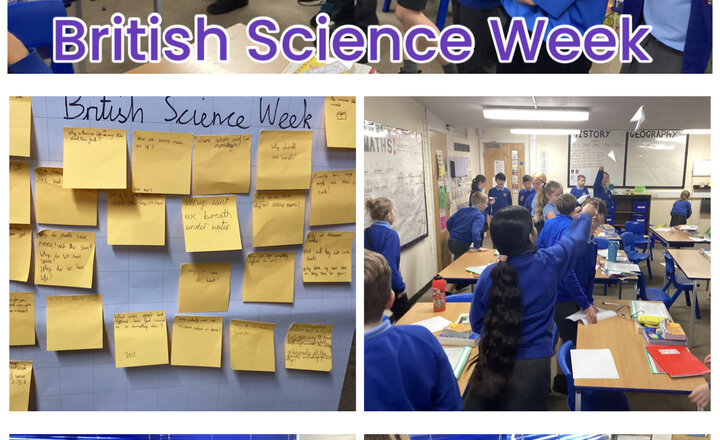
To celebrate British Science Week, Year 5 discussed the nature of curiosity and how it drives our exploration and understanding of the natural world. Each child wrote down a question they would like to answer, and we started by explaining a blood moon. We then explored the aerodynamics of paper planes and worked in groups to develop and improve the initial design. The children worked as scientists, collaborating and testing new ideas.
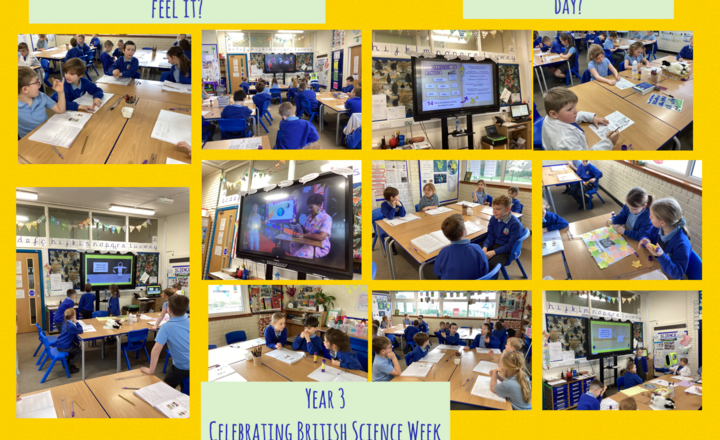
What’s Your Question? Year 3 Celebrates British Science Week 2026
Year 3 officially launched British Science Week with an "out-of-this-world" experience! Our budding scientists dived into a 'Horrible Histories; Science Live Lesson, joined by Grace Webb, 'The Rapping Science Teacher' Matt Green, and legendary astronaut Tim Peake. Together, we investigated the mysteries of light energy and our solar system, separating "science fact" from "science fiction. Inspired by this year’s theme, ‘Curiosity: What’s your question?’, the classrooms became hubs of oracy and debate. Pupils took centre stage to practice speaking and listening. The children then had questions of their own. How does the Moon stay in the sky? What does space actually smell like? What would happen if the Earth stopped spinning for just one second? We also turned our curiosity inward, creating Time Capsules in a Jar to capture who we are now and who we hope to become by the end of the year. It’s been a fantastic start to a week of big questions and even bigger ideas! What’s your question?
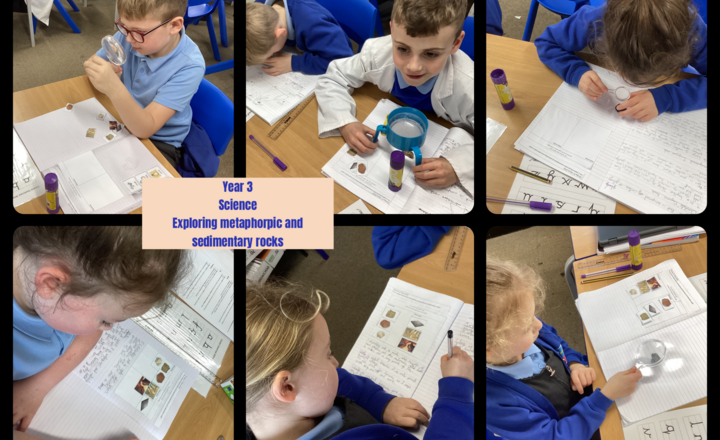
Year 3- Science-Exploring the formation and properties of sedimentary and metamorphic rocks
This afternoon, our Year 3 scientists investigated the fascinating formation and properties of sedimentary and metamorphic rocks. By carrying out a series of comparative tests, the children explored the durability, permeability, and density of various specimens, even using microscopes to search for embedded crystals. They applied their scientific enquiry skills to determine how these physical properties dictate a rock's everyday use, such as why marble might be chosen for a statue or sandstone for a building. It was wonderful to see them reporting on their findings with such enthusiasm as they grouped their rocks and compared them to their previous learning on igneous formations.
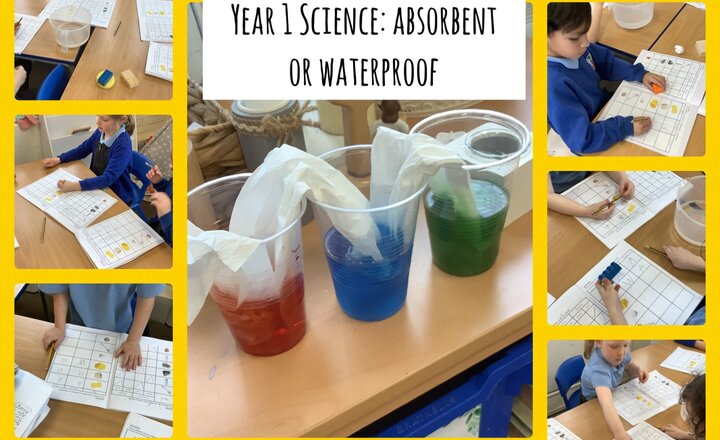
Year 1 Science: Absorbent or Waterproof
This week, we have learnt two new words: absorbent and waterproof. If something is absorbent, it will soak up water and if something is waterproof, water will not go inside the object and will drip off. In groups, we tested different objects made from a variety of materials to see if they are absorbent or waterproof. After that, we did a rainbow water test. We made 3 colours of water and used an absorbent tissue to dip into each cup. The tissue soaked up the water and changed colours, which was very exciting.
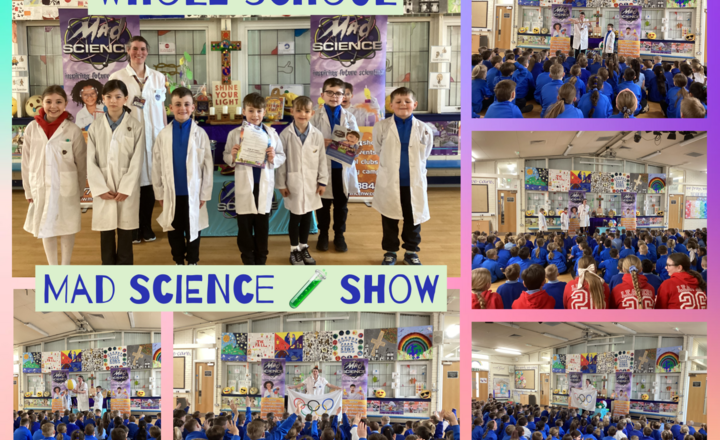
Mad Science Assembly-Going for Gold with Scientific Erica
Today, our students were treated to a spectacular, high-energy show by "Scientific Erica" from Mad Science. From Olympic-themed fire demonstrations to using gas to inflate giant balloons, the room was filled with "wow" moments and non-stop laughter. Under the expert supervision of Erica, a trained professional in chemical and fire safety, the children stepped into the role of scientists, making predictions and testing their theories in real-time. It was a memorable day that proved science is as much fun as it is educational! A special shout-out goes to our Science Ambassadors, who were a fantastic help throughout the event. Children in Years 1-4 have been given a letter with information about a Mad Science after school club next half term. It starts 13th April with new topics. Deadline date to register is 03.03.26. First come, first served. https://northengland.madscience.org/signin.aspx?successURL=%2fmyschedule
.jpeg)
Year 5 - Science
We continued our topic of Space by exploring why the Moon appears as different shapes and sizes in the night sky. The children revisited core concepts such as how the Earth rotates on its axis and how the Moon orbits the Earth. Combining these ideas with the light from the Sun, the children were able to understand how the different phases of the Moon emerge. We worked in groups to simulate the solar system using torches and table tennis balls, allowing children to see the phases in real time.
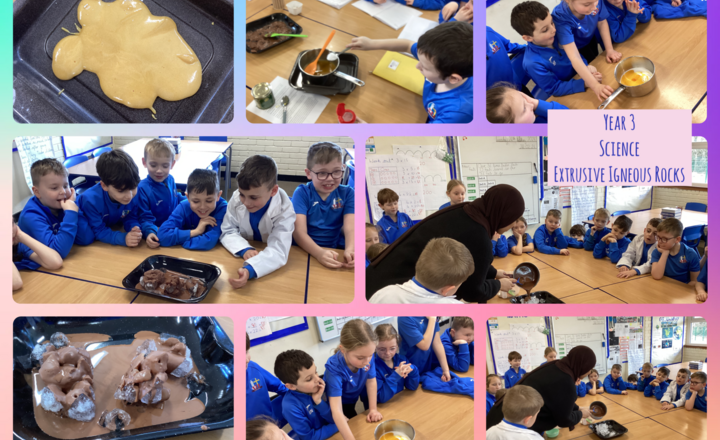
Year 3- Science- An Investigation into Igneous Rock Formation
Today, the children stepped into the roles of geologists to explore the fiery origins of igneous rocks. We began by investigating how magma (molten rock) from beneath the Earth's surface transforms into solid rock through cooling and the formation of crystals. The class compared intrusive igneous rocks, which cool slowly underground to form large crystals, with extrusive igneous rocks, which cool rapidly on the surface. To see this in action, we conducted two "delicious" experiments: first, we poured a hot chocolate and coconut oil mixture over ice to mimic the instant cooling of obsidian, resulting in a smooth, glass-like finish. Next, we created "honeycomb" rock by adding bicarbonate of soda to a hot sugar syrup; as the mixture foamily solidified, it trapped gas bubbles inside, perfectly demonstrating the porous, lightweight texture of pumice. Through these hands-on models, the children successfully reported on how temperature and trapped gases dictate the appearance and physical properties of the rocks we see on Earth today.